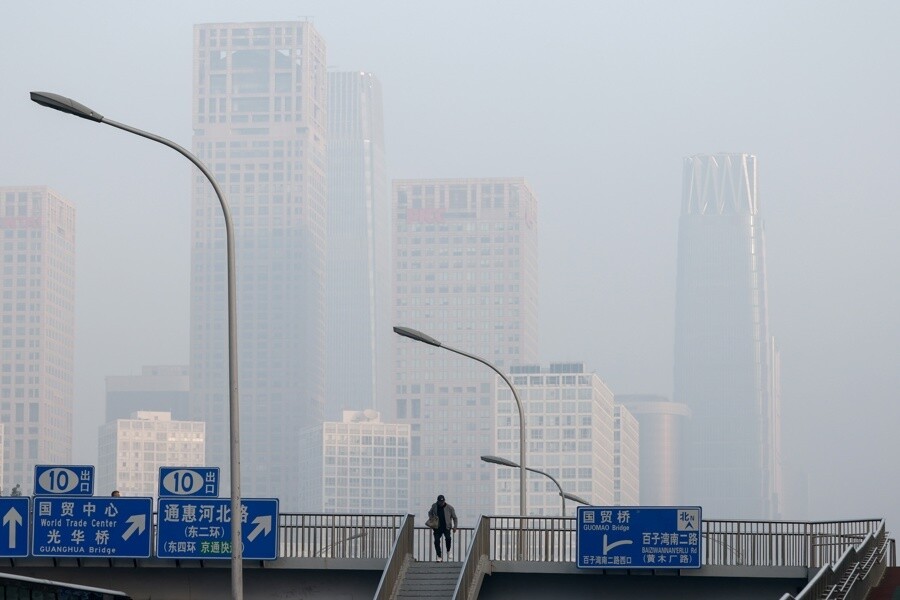
China arrives at the Belém climate summit as an indispensable yet questioned actor, determined to consolidate its image as a green power, even though its energy model remains anchored in coal. The country, the world's largest emitter of greenhouse gases and the biggest global investor in renewables, seeks to balance climate ambition with economic stability. On the eve of COP30, the challenge for Beijing is not only technical but also political: to demonstrate that its 'green leadership' can be sustained without abandoning the coal that fuels its growth. 2035 Goals and Green Diplomacy Vice Premier Ding Xuexiang, a member of the Politburo's Standing Committee, will represent China on November 6 at the COP30 leaders' day as a special envoy of President Xi Jinping. The Chinese Foreign Ministry assured at a press conference that the country 'is willing to inject greater momentum into global climate governance with its achievements and solutions' and that 'it hopes to cooperate with all parties to defend multilateralism, strengthen solidarity, and promote the global transformation towards a green and low-carbon world.' In September, the government presented its new goals for 2035: to reduce emissions by 7-10% compared to the peak expected before 2030 and to raise the proportion of non-fossil energy above 30% of total consumption. 'China has presented its new nationally determined contribution and built the world's largest and fastest-growing renewable energy system,' Xi stated at the APEC summit in South Korea. According to the official Chinese press, the next Five-Year Plan (2026-2030) will advance towards a 'clean, low-carbon, safe, and efficient' transition, prioritizing 'building the new before dismantling the old.' The speech combines prudence and global projection: a 'gradual and orderly' transition that seeks to reconcile growth and emission reduction, in line with the principle of 'common but differentiated responsibilities' that Xi reiterated at international forums. Green Leadership and the Fossil Dilemma China concentrates the largest electrical capacity on the planet, but also the greatest dependence on coal. According to the National Energy Administration, renewable sources already represent 56% of installed capacity, although energy sector emissions increased by 0.4% in 2024. The Chinese Academy of Engineering calculates that the country 'has developed less than one-tenth of its renewable technical potential,' but fossil fuels remain the pillar of its energy security. A report from the Ministry of Ecology and Environment warns that 'the challenge of maintaining a high pace of economic growth and cutting emissions makes environmental goals a complicated objective.' The ministry maintains its goal of eradicating 'severe pollution' in major cities during 2025, with a national average of 29.3 micrograms of PM2.5 per cubic meter, according to the latest official data. 'The blue sky is not expected, it is fought for,' declared in February Li Tianwei, head of the Atmospheric Environment Department. The Lancet Countdown 2025 report alerts to historic highs in eight health risk indicators, from heat stress to sleep loss, and an exposure to extreme rainfall and droughts that has doubled in three decades. Even efficiency initiatives present environmental dilemmas: the new Polar Silk Road, which completed its first voyage to Europe via the Arctic in October, promises lower costs and emissions, but depends on accelerated ice melt. 'The Arctic will not replace the Suez Canal tomorrow, but it will become an important complement,' noted to The Paper Malte Humpert, of the Arctic Institute. Climate Diplomacy and South-South Cooperation In a scenario marked by geopolitical tensions and Western retreat, Beijing seeks to reinforce its image as a reliable partner for the Global South. On October 30, the Ministry of Commerce published new guidelines to 'accelerate green and low-carbon trade,' with measures to train companies, certify sustainable products, and set carbon pricing mechanisms. The initiative reinforces its projection as a provider of green public goods—clean energy, satellite data, and low-carbon logistics—for other developing economies. As part of that strategy, international researchers in Nature Geoscience stressed the need to open access to Earth observation data generated by the Fengyun, Gaofen, or TanSat satellites to 'enrich the global record and strengthen China's role in space cooperation and the fight against climate change.'