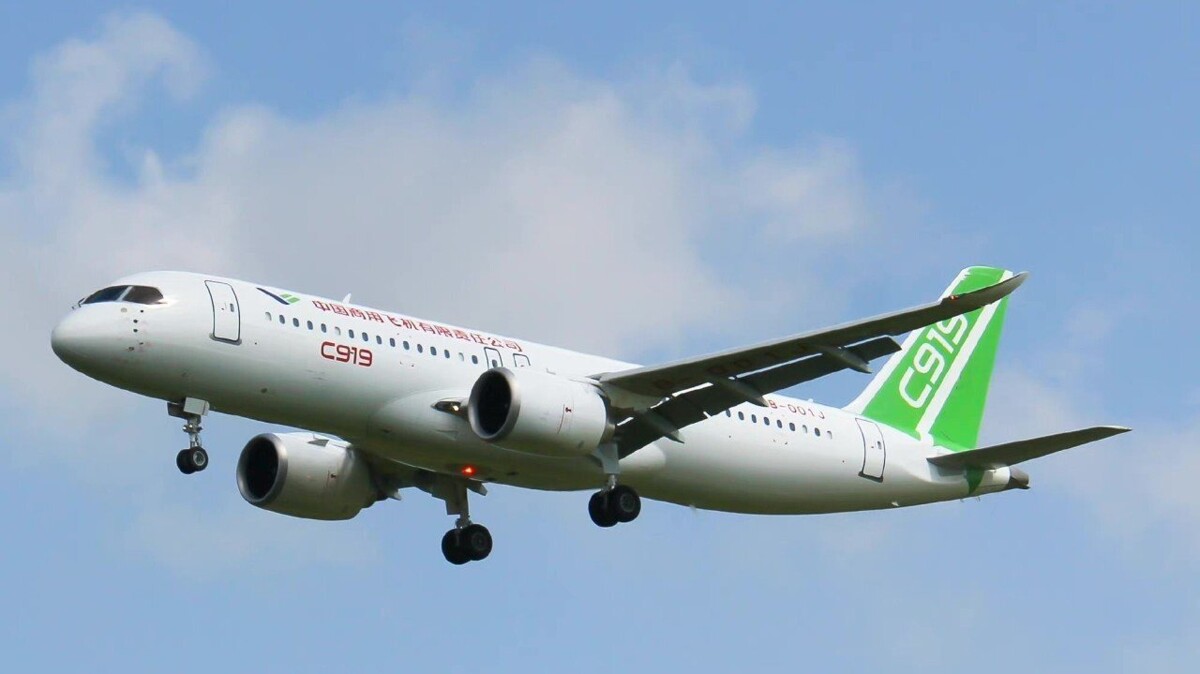
At the beginning of 2026, the COMAC C919, developed by the Commercial Aircraft Corporation of China (COMAC), has become the first genuine structural challenge to the historical duopoly formed by Airbus and Boeing. This single-aisle aircraft, designed to compete in the market's most profitable segment (dominated by the A320 and B737 families), is not just an industrial product but the spearhead of a state strategy to achieve technological self-sufficiency and project geopolitical influence through aviation, as Argentina's News Agency (NA) was able to find out. Background and Operational Status Since its inaugural flight in 2017 and its entry into commercial service with China Eastern Airlines in May 2023, the program has traversed a complex learning curve. During 2025, the manufacturer managed to stabilize its domestic operations, surpassing 25 annual deliveries, although below its initial projections due to tensions in the global supply chain. Currently, China's three major state airlines—Air China, China Southern Airlines, and China Eastern—operate active C919 fleets, integrating them into high-density trunk routes, such as the Shanghai-Beijing air bridge. Technical Details and Technological Dependence The C919 features a cutting-edge configuration, with a capacity ranging from 156 to 192 passengers and a range of up to 5,555 kilometers in its extended range (ER) variant. Critical Systems: Avionics and flight control systems are largely supplied by firms such as Honeywell, Rockwell Collins, and Parker Aerospace. Domestic Development: China is accelerating tests of the indigenous CJ-1000A engine, whose certification and mass production are estimated for the end of the decade, seeking to mitigate the risk of sanctions or export restrictions. Recent Milestones and International Certification January 2026 has marked a turning point with the start of evaluation flights by the European Union's Aviation Safety Agency (EASA). Market Prospects and Competition The C919's order book already exceeds 1,000 units, concentrated mainly on Chinese operators and leasing companies. Similarly, the development of variants like the C919-600 (for high-altitude airports) and the C919-800 (extended version for over 200 passengers) suggests a diversification that will attack all niches of the single-aisle market. In conclusion, the C919's impact on world aviation is currently more qualitative than quantitative. However, its international 'impact' is conditioned by a critical factor: the dependence on Western components. International interest is growing: Southeast Asian countries such as Vietnam, Indonesia, and Cambodia are evaluating the model as a faster delivery alternative to Airbus and Boeing bottlenecks. Strategic Pressure: Figures like Ryanair's CEO Michael O'Leary have publicly mentioned the C919's potential as a negotiation tool to pressure Western manufacturers on prices and delivery times, showing that COMAC is already influencing the psychology of the global market. Future Projections For 2026, COMAC projects the opening of a second final assembly line in Pudong, which would allow scaling production to competitive levels.