The mention of attacks reaching the eastern Mediterranean, such as Cyprus, and the extension of tension towards the Gulf—with the psychological impact that implies on urban centers, commercial corridors, and regional stability—feeds a question that today, no one seems able to answer with certainty: where is the ceiling of the escalation and what cost will it have to sustain it?
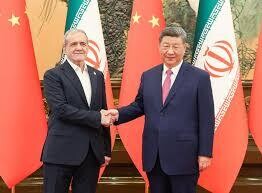
For China, the challenge is twofold. For Tehran, the support has immediate symbolic value—it is not alone—and also a practical weight: every sign of support from a permanent power on the Security Council can, at least partially, reorder the board of international pressures.
On the other side, President Donald Trump toughened the tone and, far from hinting at a brake, spoke of an imminent escalation. The president emphasized that the United States has “the best army in the world” and that it is “using it,” a phrase that sounds like a warning to both Tehran and those evaluating the costs and benefits of getting involved or stepping back.
Trump also spoke about deadlines. For the United States, Trump's speech—focused on force and an upcoming “big wave”—seeks to impose deterrence, but it also risks pushing Iran to accelerate its asymmetric responses, precisely in the places where the political and economic impact is most sensitive.
Meanwhile, in the Middle East, there is a growing feeling that the war is no longer “someone else's business.” On one hand, supporting Iran without being dragged into a military dynamic it does not control; on the other, preserving its image as an actor that talks about “de-escalation” and “stability” while clearly positioning itself alongside its partner.
At that point, every call between foreign ministers—such as that of Wang Yi and Abbas Araghchi—becomes more than diplomacy: it is an indicator of where the balance might tip in the coming days. In the same exchange, he acknowledged that the “biggest surprise” were Iran's retaliatory attacks against neighboring Arab countries—such as Qatar and the United Arab Emirates—that host sensitive infrastructure and, in some cases, Western military presence.
Foreign Minister Wang Yi spoke on the phone with his Iranian counterpart, Abbas Araghchi, and assured him of Beijing's support in defending Iran's sovereignty, security, and territorial integrity. This gesture, measured in form but firm in message, arrives as the conflict ceases to be a concentrated clash between capitals and military bases to become an expanding wave that crosses borders, energy routes, and diplomatic balances.
In recent days, Iran's response—according to various chronicles—extended beyond what was anticipated by Washington and ended up touching areas that usually remain on the sidelines of direct clashes: from installations and positions in the eastern Mediterranean to the heart of the Gulf monarchies, where key logistical enclaves operate and where tourism and investments coexist with a growing sense of vulnerability.
In this context, the call between Wang Yi and Abbas Araghchi functions as a kind of geopolitical “marking”: China not only tries to position itself as an actor with influence, but also protects its own strategic equation in a region vital for global trade and energy flows.
When drones and missiles approach countries that used to buy security through alliances and fortifications, fear changes its language: it ceases to be abstract geopolitics and becomes daily life.
In a phone conversation with host Jake Tapper, the head of state stated that “the biggest wave” of the operation against Iran has not yet occurred and is “yet to come.”
“We are wiping them out,” he said, describing an offensive that—according to his vision—is “going very well” and with a firepower that he insisted has not yet been deployed in its full dimension. Asked about the possible duration of the war, he estimated it would be around “a month” and assured that the operation is “a bit ahead” of what he had anticipated.
In his account, those countries “were going to participate very little” and now “insist” on getting involved, a recognition that exposes the risk that the dynamics of the conflict end up dragging in actors who preferred to remain on the sidelines.
In parallel, the episodes reported in different points on the map reinforce the idea of a conflict that is spilling over.
Beijing- March 3, 2026-Total News Agency-TNA—In a high-voltage political signal, China came out to explicitly support Iran amid the full expansion of the war in the Gulf.