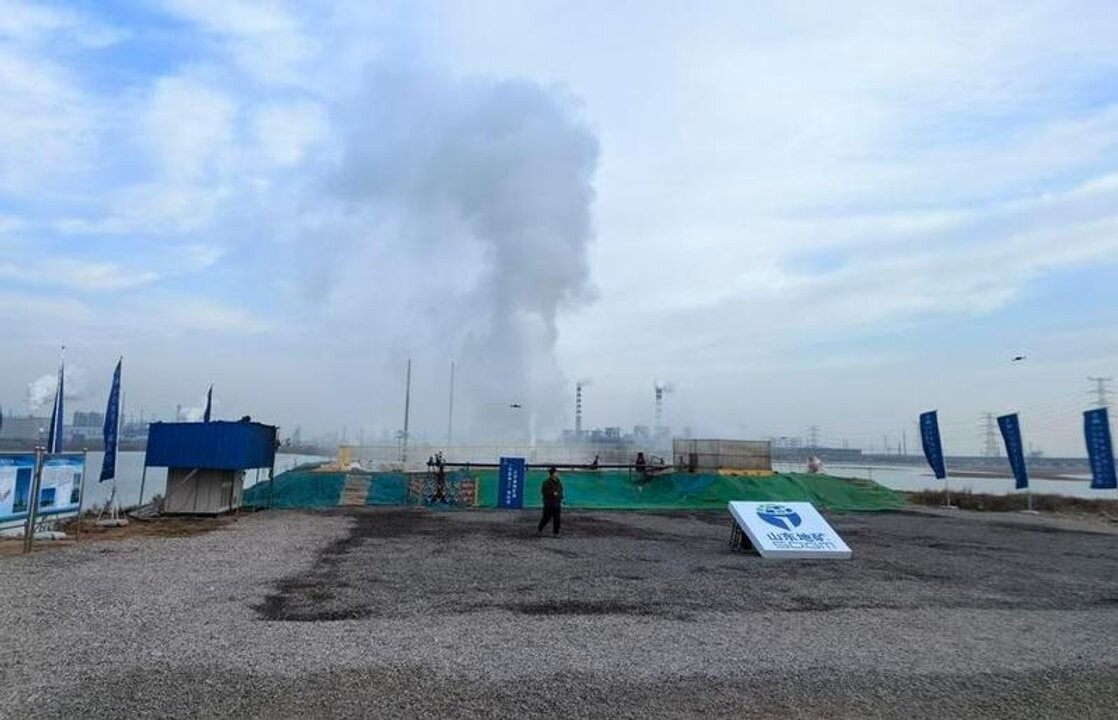
China has reached a new milestone in its transition to clean energy with the successful drilling of a high-temperature geothermal well in Shandong Province. The Provincial Bureau of Geology and Mineral Resources announced the completion of the works in the Yellow River delta on Friday, achieving unprecedented efficiency parameters for the region. The well recorded a temperature of 162 degrees Celsius at its bottom and 138 degrees at the water's surface. According to Zhang Yunfeng, director of the Shandong Institute of Geo-mineral Exploration, the stable thermal power is estimated at 21.57 megawatts, representing a significant potential for the local energy matrix. The impact of this new resource translates into concrete figures for sustainability: it could produce about 25,200 kilowatt-hours daily, enough to cover the demand for 10,000 residents; it has the capacity to supply 94,000 tons of steam per year, which would replace 18,800 tons of coal; an estimated 48,900 tons of carbon dioxide will be saved annually. The project stands out for its circular economy system. Once used for power generation or industrial processes, the remaining water (at 80 degrees) will be used for district heating in residential areas covering nearly two million square meters. Even the final residual heat, at about 60 degrees, will be utilized in smart greenhouses and large-scale aquaculture projects, closing a complete cycle of total resource utilization. China, which already leads the world in the scale of direct geothermal energy use, plans to expand these models to strengthen both public welfare and sustainable economic growth through stable, low-emission renewable resources.