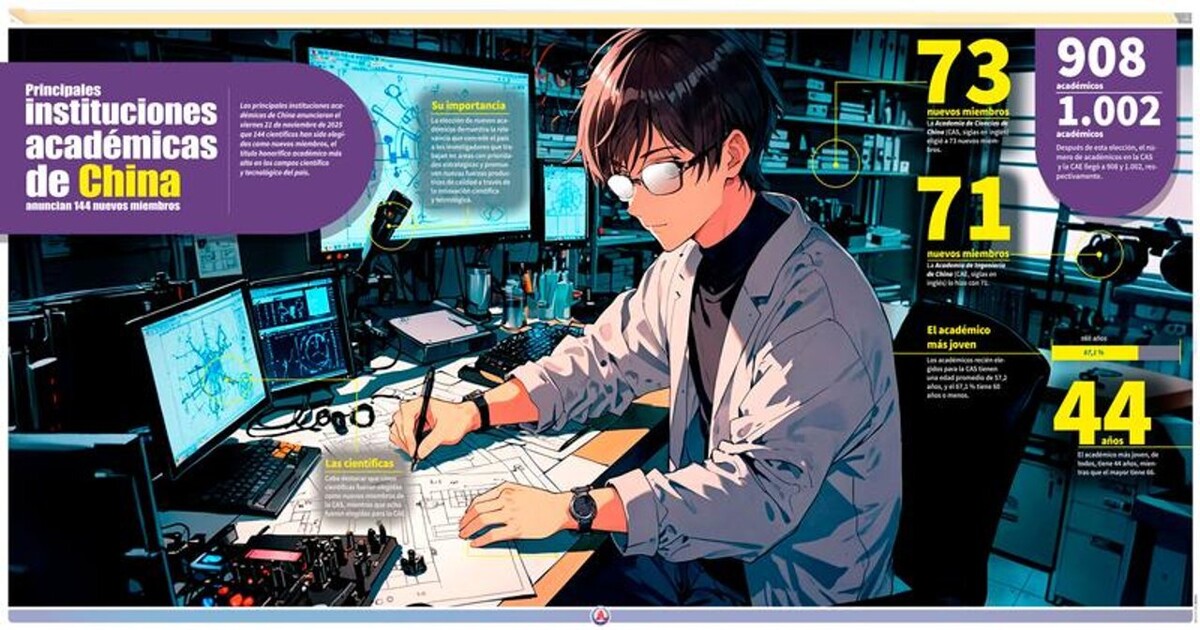
BEIJING, Nov 21 (NA/Xinhua) – 144 scientists were elected this Friday by China's leading academic institutions as new members, the highest academic honor in science and technology in the country. The breakdown shows that the Chinese Academy of Sciences (CAS) appointed 73 new members, while the Chinese Academy of Engineering (CAE) appointed 71. Five scientists were elected as new CAS members, while eight were elected to the CAE. After this election, the number of academicians in the CAS and CAE reached 908 and 1,002, respectively. The newly elected CAS members have an average age of 57.2, and 67.1 percent are 60 years old or younger. The youngest is 44 years old, while the oldest is 66. The election of new academicians demonstrates the importance the country places on researchers working in strategic priority areas and promoting new quality productive forces through scientific and technological innovation, according to information collected by Noticias Argentinas. In a publication by the prestigious English weekly The Economist, upon which an article published by Austral University by Daniel Martello is based, it is analyzed how China became a scientific superpower. Chinese scientists surpassed the rest in several high-quality science indicators: the old domain of European and American science seems to have concluded. In 2003, the United States had produced 20 times more high-impact articles (publications most frequently cited by other scientists in their own work) than China, according to data obtained from Clarivate – Web of Science, the scientific analysis company. By 2022, China had already surpassed both the United States and the European Union (EU). The Leiden Ranking, a recognized academic classification of universities based on bibliometric indicators that measure research productivity and impact, shows the volume of high-quality scientific research production (top 1% most cited), in hard sciences and engineering and in mathematics and computer science. In medical and biological sciences, the superiority of North American universities can still be seen. Student Emigration Between 2000 and 2019, more than 6 million Chinese students left the country to study abroad, according to China's Ministry of Education. In recent years, many of them have returned, bringing with them newly acquired skills and knowledge. OECD data suggest that since the late 2000s, more scientists have returned to the country than have left, thanks to the generation of research talent that includes economic incentives and grants. In 2006, the CPC published its vision of how science should develop over the next 15 years and meticulously invests money in strategic areas that include quantum technologies, artificial intelligence, semiconductors, neuroscience, genetics, biotechnology, regenerative medicine, and the exploration of deep space, deep oceans, and the Earth's poles. In the field of quantum computing, some of the country's academic laboratories are on par with Western commercial laboratories in terms of scale. In 2023, researchers working in China broke the record for the number of entangled quantum bits, or qubits, within a quantum computer. Nature Index China now leads the world in other benchmarks that are less prone to manipulation. For example, it leads the Nature Index, created by its namesake publisher, which counts contributions to articles appearing in several prestigious journals. Articles must be approved by a panel of reviewers that assess the quality, novelty, and potential impact of the study. In 2014, China ranked second in natural sciences publications, but its contribution to the selected titles was less than a third of that of the United States. By 2023, China had reached the top spot. The transformation of Chinese science was achieved by focusing on greater investment in research and development (R&D). In real terms, China's spending on R&D multiplied by 16 since 2000. According to the latest OECD data, in 2021, China was still behind the United States in total R&D spending (668 vs. 806 billion dollars). But in terms of spending by universities and government institutions only, China and the United States are at similar investment levels (between 130 and 140 billion dollars). The United States spends about 50% of its budget on basic research, almost double that of China. The creation of world-class universities and government institutions has also been part of China's scientific development plan. Initiatives such as the 'Project 211', the '985 Program', and the 'China Nine League' gave money to selected laboratories to develop their research capabilities. Universities paid significant bonuses to staff if they published in high-impact international journals.