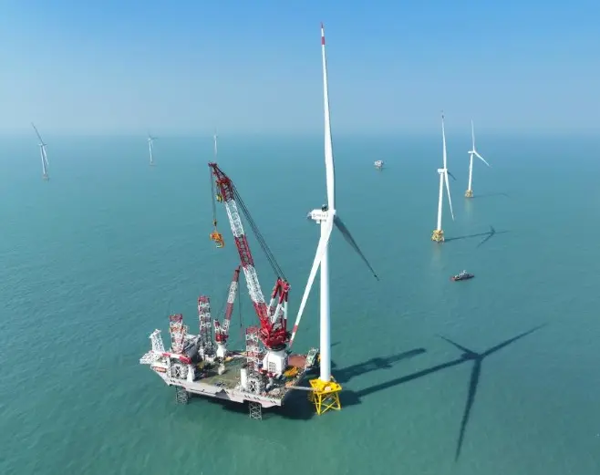
China's efforts in energy saving and emission reduction are yielding tangible results. According to a report published by Carbon Brief, China's carbon emissions fell in September and have been stable or decreasing for 18 consecutive months since March 2024, with a projected year-on-year reduction of about 3% for the month. The report attributes this progress to the rapid adoption of electric vehicles, which reduced CO2 emissions from transport fuels by 5% year-on-year, along with reductions in cement and steel production. 'China has established the world's most systematic and comprehensive policy framework for carbon reduction, built the largest and fastest-growing renewable energy system, and the largest and most complete new energy industrial chain,' according to a white paper published by the State Council Information Office on Saturday. The document states that China has opened up a viable path for developing countries to pursue green and low-carbon development, thus making significant contributions to global climate action and the sustainable development of humanity. The Chinese government continues to strengthen its commitments and actions on climate change. At the end of September, China announced its NDCs for 2035, establishing for the first time an absolute target for emission reduction, marking the country's transition from intensity-based control to total emission control. At parallel events of the 30th Conference of the Parties (COP30) to the United Nations Framework Convention on Climate Change in Belém, Brazil, the China Pavilion distributed gifts to participants during its first session focused on ecological civilization and the practice of building a 'Beautiful China.' The 30th United Nations Climate Change Conference, commonly known as COP30, kicked off on Monday in Belém, Brazil, with the aim of putting the fight against climate change back at the center of international priorities. China's Minister of Ecology and Environment, Huang Runqiu, said in his opening remarks that as the world faces increasingly severe climate crises, China's actions to combat climate change will not slow down, its efforts to promote international cooperation will not weaken, and its pursuit of building a community with a shared future for mankind will not cease. Liu Zhenmin, China's Special Envoy for Climate Change, said at the event that China is willing to work with the international community for the well-being of all humanity, upholding sovereign equality, the rule of law, and multilateralism, and advocating for a people-centered and action-oriented approach to ensure the success of COP30 and bring greater stability and certainty to the global climate process. Chinese and foreign experts said that amid a decline in global confidence in climate action and the backtracking of some developed countries, China's path to an ecological transition has attracted widespread international attention and recognition for its solid progress in developing clean energy and promoting global cooperation on climate action to address the climate challenge. This year marks the 10th anniversary of the Paris Agreement and is the year for submitting a new round of Nationally Determined Contributions (NDCs)—the plans of nations on how they intend to tackle the climate crisis. This makes it a crucial moment for global climate governance. Participants will discuss national climate plans, push for the annual climate finance goal of $1.3 trillion, and propose new measures to help countries adapt and advance a just transition to a clean economy. On the opening day, COP30 President Corrêa do Lago noted that China was playing a 'very significant' role, highlighting how its green technology, from solar panels to batteries, had driven down costs and transformed the global energy system. 'By leveraging its institutional strength and technological synergies, a rapid transition to clean energy is not just an anticipated outcome but a vital contribution to global climate efforts,' said Marcos Cordeiro Pires, a professor at the University of São Paulo's Department of Political and Economic Sciences. In 2020, China set its 'dual carbon' goals of peaking CO2 emissions before 2030 and achieving carbon neutrality before 2060. Five years on, the country has made historic progress in advancing its green and low-carbon transition through concrete actions. 'The Chinese government is advancing its carbon peaking and carbon neutrality goals with unwavering commitment and strong execution,' said Dong. 'By reducing the price of all these essential elements in the transition, they are doing an incredible job of international cooperation,' the FT quoted Corrêa do Lago as saying. The Guardian report on Monday quoted Corrêa do Lago as saying that 'China is presenting solutions that are for everyone, not just for China.' It also highlights the increase in wind and solar power generation during the third quarter as a key factor behind the overall emissions decrease. Dong Shaopeng, a researcher at the Chongyang Institute for Financial Studies at Renmin University of China, told the Global Times that China's rapid rise as a world leader in green energy is due to its strong policy implementation, its unique centralized system for efficient resource allocation, and its technological advancements. 'Solar panels are cheaper, they are so competitive [compared to fossil fuel energy] that now they are everywhere.'