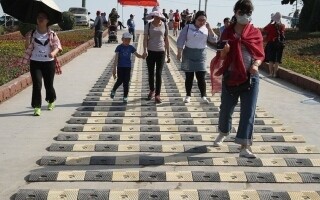
In an unconventional move to manage tourist flow and protect one of the country's most important historical sites, Chinese authorities have installed what resemble speed bumps for pedestrians on one of the paths leading to the famous Grand Canal. This measure aims to slow down visitors who spend a long time looking at their phones instead of enjoying the historical view.
Dozens of rubber bumps in black and yellow appear on a pedestrian walkway in the historic town of Taierzhuang, located along the Grand Canal between Beijing and Hangzhou. Speed bumps are typically used to slow vehicle traffic in sensitive areas like residential neighborhoods, schools, and hospitals, and their shape and size vary according to local laws, but their height usually ranges from 3 to 6 inches.
However, Chinese authorities decided to use this idea in a completely different way, placing the bumps on a pedestrian walkway to slow down tourists and encourage them to stop and observe the surrounding historical scenery. The project is located in the ancient town of Taierzhuang, which is one of the important historical stations along the Grand Canal—the world's longest and oldest artificial waterway. The canal's history dates back to around 486 BC and has been listed as a UNESCO World Heritage site for its historical and engineering value.
According to local authorities, officials noticed that thousands of tourists who visit the site daily spend a large part of their visit engrossed in their smartphones—whether taking photos or browsing the internet—instead of contemplating the historical landmarks and ancient buildings dating back to the Qin and Han dynasties.
To address this phenomenon, more than 50 rubber bumps were installed on the path leading to the main canal viewing platform. Officials preferred to describe these bumps as "traffic calming devices" rather than speed bumps, indicating their purpose is to slow pedestrian traffic, not to hinder them.
Soon, the walkway gained an unofficial nickname among visitors as the "washing board road" due to its wavy shape resulting from the sequence of bumps. This step aims to encourage tourists to slow down their walking pace, giving them an opportunity to stop and admire the historical view of the Grand Canal, which stretches for about 1,104 miles between Beijing and Hangzhou and is one of the most prominent engineering achievements in Chinese history.
As noted by the China National Tourism Administration in Singapore, the Grand Canal features a long series of photogenic tourist attractions stretching over 12 kilometers from north to south. Photos show that the pedestrian bumps do not cover the entire width of the walkway, as clear spaces are left on both sides of the road, allowing those who wish to avoid them to pass easily.