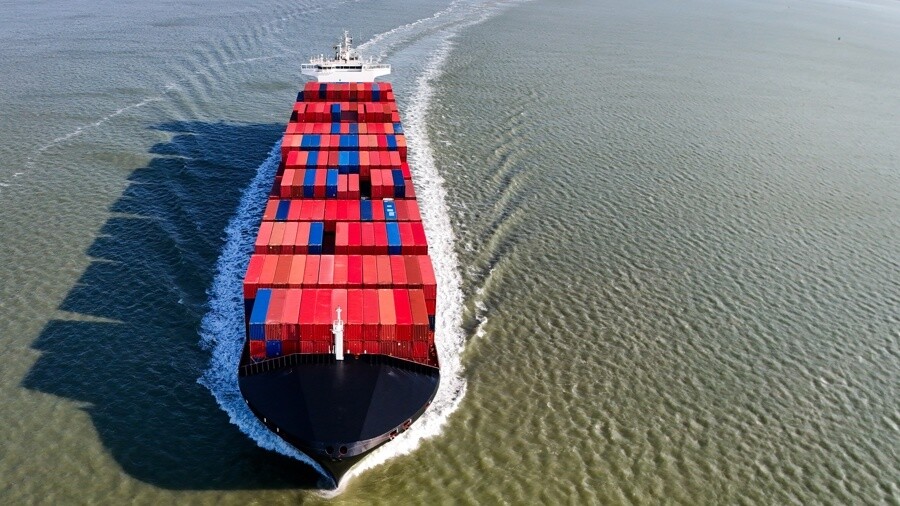
The cost of maritime freight transport between Shanghai (China) and Europe has surged by 22% in the first month of the Middle East conflict, which has led to Iran's closure of the Strait of Hormuz, a critical chokepoint for global oil and fertilizer trade. The impact of the conflict in both the Strait of Hormuz and the Red Sea has affected the cost of transporting a 40-foot container. On the route from Shanghai to Genoa (Italy), the cost has increased by 22.93%, with this week's price standing at $2,826. Meanwhile, the route from the same Chinese city to Rotterdam (Netherlands) has reached $2,552 per container this week, marking a 21.87% rise compared to the cost recorded last February 26. In fact, over the past week, freight rates between Shanghai and Rotterdam have increased by 2.99%, rising from $2,478 to $2,552. Conversely, the price increase on the route between the same Chinese city and Genoa was 11.78%, as it went from $3,108 to $3,474, according to data collected by Bloomberg. Prior to the attacks by the U.S. and Israel on Iran (which began on February 28), freight rates on both routes had been decreasing for seven consecutive weeks, with the last increase occurring in the first week of January, up 10%, following the arrest by the United States of former Venezuelan President Nicolás Maduro. The general secretary of the Spanish Shippers' Association (ACE), Nuria Lacaci, explained to EFE that, as a result of the Middle East conflict, in addition to the increase in freight rates themselves, there is also a series of surcharges from shipping companies due to war risks, fuel price adjustments, and port congestion. Marine insurance premiums have also "multiplied in recent weeks," which means costs "more than double what was paid per container" before the war, a situation that "will likely continue to escalate," she warned. Lacaci emphasizes that while there is currently no lack of capacity, there are still containers that have not been repositioned because they are trapped in the Persian Gulf area. She also points out that next week, ports may face difficulties in unloading all the ships that will arrive at the same time, "as those that came around the Cape of Good Hope coincide with those that had to take the same route due to the closure of the Strait of Hormuz." This situation "could indeed cause a shortage of supply, which would contribute to the rise in freight rates," the general secretary of the Spanish Shippers' Association (ACE) stresses, also noting that there are also co-management problems in alternative ports on the west coast of Saudi Arabia, southern Oman, or Sri Lanka.