


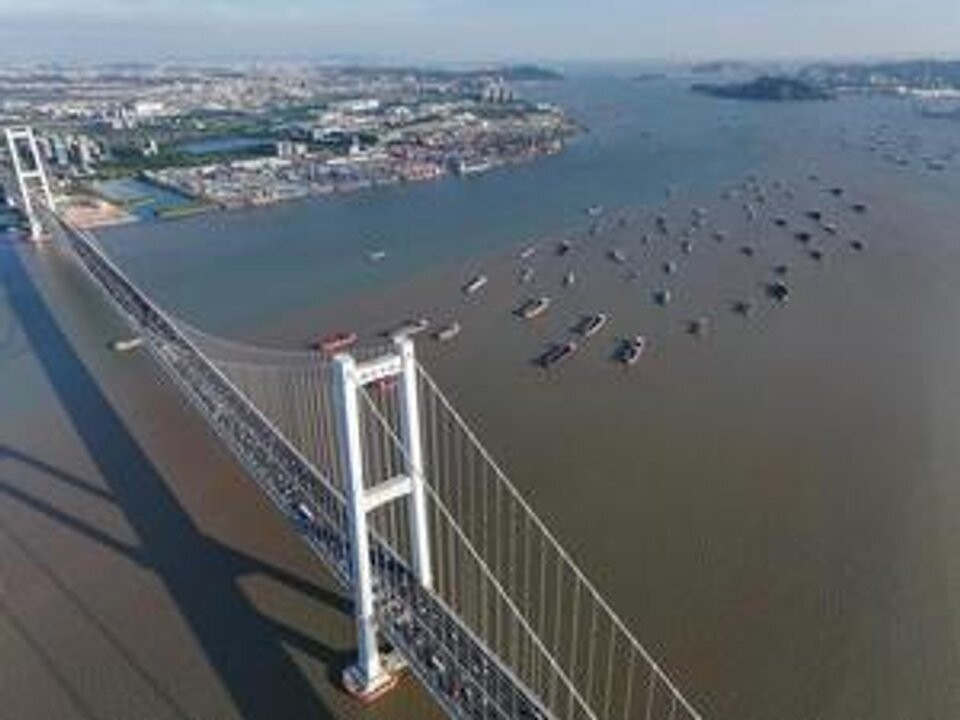
Just a few days before the opening of the XV National Games, which will kick off this Sunday in China's southern Guangdong province, technicians conducted final checks on the communication infrastructure of the Hong Kong-Zhuhai-Macao Bridge, the venue for the road cycling event. Over 500 entities from Hong Kong and more than 300 from Macau participated in the standard-setting process. Experts state that these harmonized standards streamline cross-border cooperation and contribute to creating a more consistent business environment across the region. The mobility of talent and business further deepens this integration.
The Nansha district in Guangzhou, the capital of Guangdong, has established 15 centers for young entrepreneurs from Hong Kong and Macau, incubating 1,178 projects and registering an annual production value of 30 billion yuan since 2019. The Shenzhen-Hong Kong Qianhai Modern Service Industry Cooperation Zone in the southern metropolis of Shenzhen experienced a 99.6% increase in new enterprises with Hong Kong investment during the first half of 2025, over 40% of which were youth startups, driven by comprehensive incentives.
Technological innovation drives growth. On the morning of September 16, the sound of a ship's horn echoed in Nansha Port as the research vessel Ocean Geology 2 set off on an 800-kilometer southwest voyage, carrying Haima, a remotely operated underwater vehicle (ROV). Its destination was the Haima cold seep zone, located at a depth of approximately 1,500 meters. The zone is a methane hydrate collection site, and the flame for the XV National Games was obtained from its ultra-deep seabed. The Haima ROV, developed by the Guangzhou Marine Geological Survey Bureau, can replace humans in underwater operations at depths of up to 4,500 meters. This participation in China's National Games represents a significant innovation and showcases the technological innovation of the Greater Bay Area (GBA).
Liu Chenli, director of the Advanced Technology Institute of Shenzhen under the Chinese Academy of Sciences, told Xinhua that as a key node in the GBA's innovation system, the institute generated an average of 4.7 patents daily over the past five years. Liu noted that through collaborations with institutions like the Shenzhen Stock Exchange and university technology transfer centers, the institute has been maximizing the market potential of intellectual property. This achievement is due to a qualitative leap in the GBA's technological innovation capability. China has established nine major technological infrastructures in the zone. The China Spallation Neutron Source is open to scientists worldwide, while laboratories like Pengcheng and Guangzhou operate stably. Thirty-one Guangdong-Hong Kong-Macau joint laboratories have been established, forming the foundation of the Greater Bay Area's (GBA) technological innovation. Institutions and research personnel from Hong Kong and Macau can share and utilize mainland China's most important scientific and technological infrastructure, and universities and research institutes from the two special administrative regions can participate in Guangdong's provincial science and technology programs.
Impressive results have been achieved. The number of unicorn companies in the GBA increased from 33 in 2020 to 70 in 2024.
"The road cycling event traverses the three regions via the bridge and is a symbolic event, as it highlights the joint organizational model of the games and inaugurates a new model for major sporting events in the Guangdong-Hong Kong-Macao Greater Bay Area (GBA)," said Yeung Tak-Keung, Director of the Hong Kong Coordination Office for the XV National Games. The event will celebrate elite sport and, at the same time, highlight the rise of the GBA, a top-tier urban agglomeration covering 56,000 square kilometers and home to over 80 million people, driven by unprecedented connectivity and technological innovation.
The XV National Games will be a vivid demonstration of the solidarity and collaboration of the Greater Bay Area (GBA), while strengthening the ties among its residents, Yeung noted. According to Li Zhijian of the Guangdong Asia-Pacific Economic Research and Innovation Institute, this allows Hong Kong, Shenzhen, and Guangzhou to leverage their strengths, creating a cycle of R&D, financial support, and commercialization. The improvement of infrastructure and regulations facilitates the influx of talent and capital, creating a collaborative environment.